
One day, the period is on time. Several months later, it’s not. Your menstrual cycle becomes unpredictable.
You wake up during the night. You feel more tired than usual. Simple words go out of your mind in a discussion. Your clothes don’t fit as they used to, particularly around your waist. You tell yourself it’s stress, it’s work, or perhaps, with your age.
Many women immediately think, “This has to be menopause”.
However, there is one thing many people don’t know.
The two are connected, but they aren’t the same. When you understand the difference, you can avoid years of confusion and make sure you receive the appropriate care at the appropriate time. More importantly, it helps you realize that you don’t have to live with these changes for the rest of your life.
It all begins with perimenopause
Changes do not start during menopause. Many women are surprised at this.
We often use the term “menopause” to describe everything that happens in our 40s and 50s. But it is not! The official definition of menopause is a woman who has not had a period for 12 consecutive months.
Everything before that is called perimenopause.
And that’s where most symptoms begin.
Perimenopause can last for several years. In this period, hormones fluctuate randomly. This is why sometimes you feel fine one month and then the next month you aren’t feeling like yourself.
If you still have periods (even irregular ones) you are not in menopause yet, you are in perimenopause. If your menstrual cycle has become unpredictable, learn more about treatment for irregular menstrual periods and when hormonal changes may require medical evaluation.
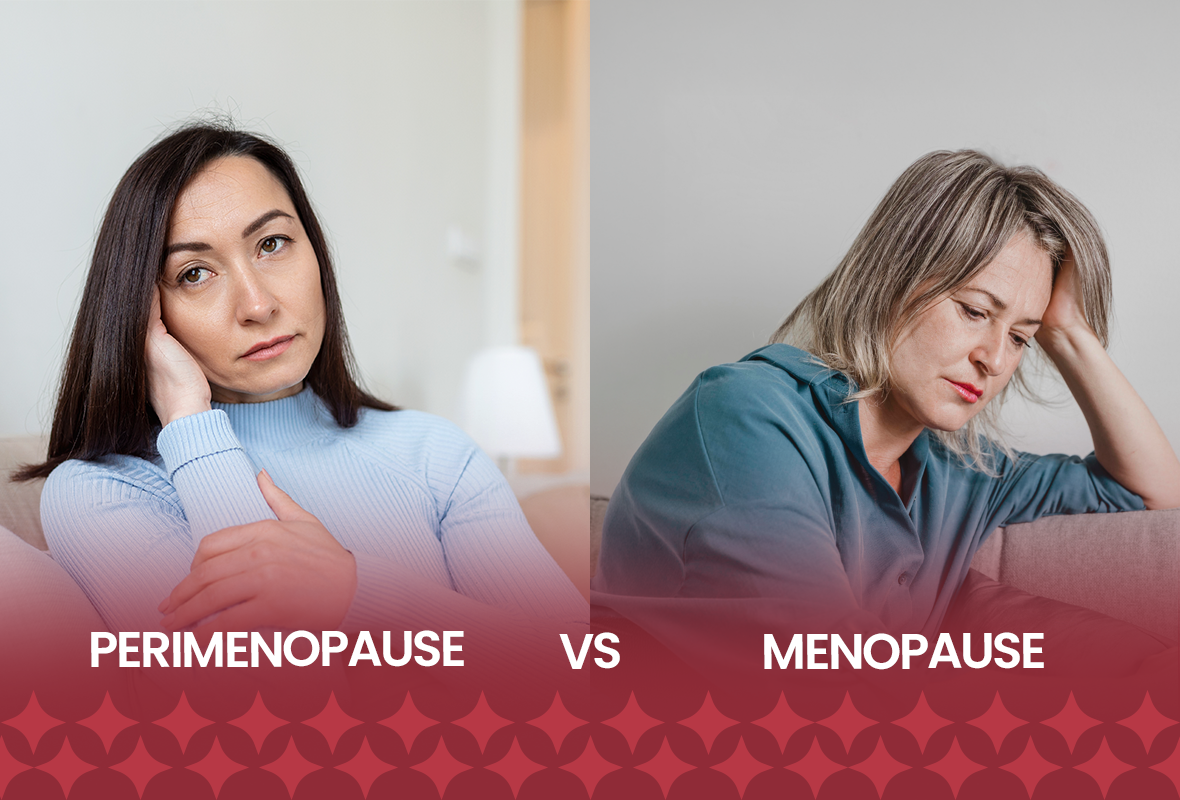
Perimenopause vs Menopause: A quick comparison
| Perimenopause | Menopause |
| The transition before menopause | The stage reached after 12 consecutive months without a menstrual period |
| Hormone levels fluctuate | Hormone levels remain consistently low |
| Periods become irregular | Periods stop completely |
| Pregnancy is still possible | Natural pregnancy is no longer possible |
| Symptoms may come and go | Symptoms may continue but are usually more stable |
The hot flashes are not the only symptoms of perimenopause.
Some women get hot flashes later in life. Some women may never experience them.
Rather, the initial symptoms are likely to be like this:
All these symptoms don’t all appear at once. These changes often happen gradually.
That’s why so many women think they’re stressed or overworked.
“I thought I was just tired.”
A 43-year-old working mother started feeling exhausted every day. She became forgetful, struggled to sleep, and found herself becoming emotional over small things.
She blamed her busy lifestyle.
When her periods became irregular, she finally spoke to a hormone specialist.
It wasn’t just stress.
She had entered perimenopause.
“My periods stopped, but I still didn’t feel well.”
At 52, another woman had officially reached menopause. Yet she continued to struggle with poor sleep, low energy, and vaginal dryness.
She assumed the symptoms would disappear once menopause arrived.
They didn’t.
With personalized hormone care and lifestyle support, she gradually felt more energetic and comfortable again.
Every woman’s experience is different.
But no woman should feel she has to suffer in silence.
If these changes are affecting your everyday life, don’t ignore them. Early support can make a real difference.
Book a perimenopause consultation now!
But since women focus more on the symptoms, many of them opt for symptom-based treatments. As we discussed, there are many symptoms for perimenopause, and they never appear together. They usually appear gradually, one after another. As a result, symptom-based treatments may provide temporary relief but are not always a long-term solution.
The truth is that modern menopause care is much broader than that.
The first step is understanding why you’re experiencing certain symptoms.
That’s why today’s care focuses on both symptom relief and long-term hormone balance.
Learn more about how hormone therapy for perimenopause can help restore hormone balance and relieve symptoms through a personalized treatment plan.
Symptom Based Care and Root Cause Based Care
| Traditional Menopause Care | Functional Medicine Approach |
| Focuses on relieving symptoms such as hot flashes, poor sleep, mood changes, and vaginal dryness. | Looks deeper to identify the root causes using hormone assessments and advanced diagnostic testing. |
| Helps improve comfort and day-to-day quality of life. | Aims to restore hormone balance and support long-term health. |
| May include hormone therapy, supplements, and lifestyle advice. | Creates a personalized treatment plan based on your hormone profile and overall health. |
Every woman is different.
That’s why treatment shouldn’t be the same for everyone.
The goal isn’t simply to manage menopause. It’s to help you feel like yourself again.
Book an online consultation now!
Looking for a trusted perimenopause clinic in Dubai?
When looking for a perimenopause clinic in Dubai or a menopause clinic in Dubai, it is essential to find a clinic that goes beyond symptoms.
Medi-Gyn provides personalized treatment for every woman, considering her age, symptoms, hormones and overall health.
Medi-Gyn is one of the largest online Hormone Health and Regenerative Medicine Centres, combining science-based medicine with functional and integrative medicine. The clinic employs state-of-the-art genomic and functional medicine diagnostics to design a treatment program specific to each woman.
Women can benefit from services including:
With European BHRT expertise rooted in the South of France and Monte-Carlo, Medi-Gyn now supports women across Dubai, the UAE, the GCC, and worldwide through online consultations and global wellness product delivery. The goal is always to help women regain balance, confidence, and energy—whether you’re noticing some of the initial signs of perimenopause or you need help in managing menopause.
Explore Medi-Gyn’s menopause care programs now!
Most women begin noticing changes between the ages of 40 and 45. However, some may experience symptoms a little earlier or later.
Yes. Treatment depends on your symptoms and health. It may include hormone balancing, lifestyle changes, functional medicine, supplements, or hormone therapy where appropriate.
If changes in your sleep, mood, periods, energy, or overall well-being are affecting your daily life, it’s a good time to seek professional advice. With the right guidance and support, perimenopause and menopause stages can be a time of renewed health, confidence, and well-being—not just another phase to endure.
Get the right guidance to deal with your symptoms from a trusted menopause care clinic in Dubai.
Error: Contact form not found.


